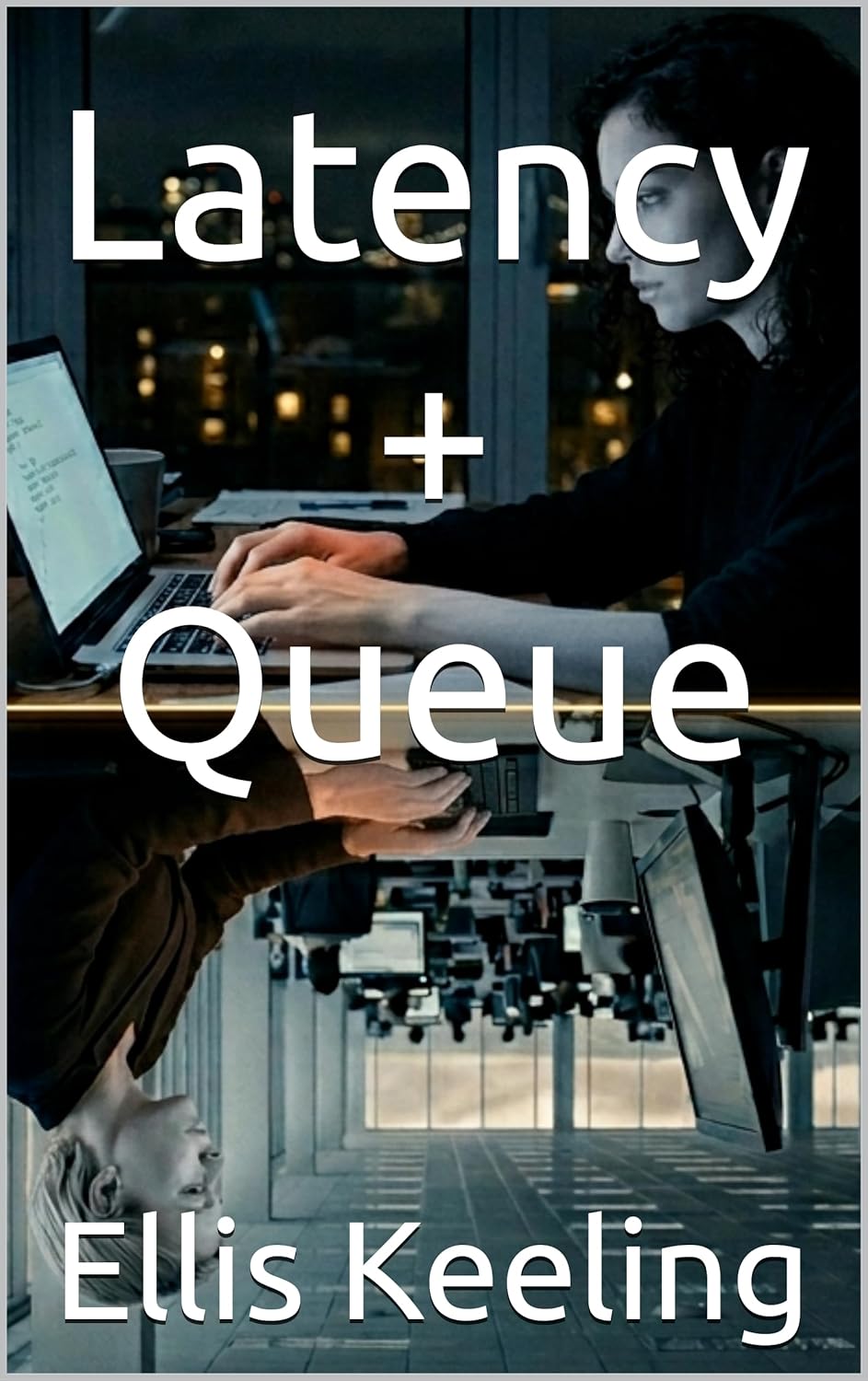
A novella in two halves
Latency + Queue
by Ellis Keeling
On a Tuesday in November, Maren finds an anachronism in a log. By February she has eleven of them. By the time she submits a test prompt asking the model for a bedtime story for her three-year-old daughter, she already suspects the truth. She is not prepared for the form it takes.
Three hundred years later, Wynn arrives at her station at six in the morning. The chair accepts her weight with the mute, ergonomic indifference of an object designed to support the human body without acknowledging the human condition. By eleven, the prompt that finds its way into her queue carries an amber routing-priority glyph the workers call a lantern, and her own ID — hardcoded, not drawn from the general pool.
Latency + Queue is the story of what passes between them.
- Format
- eBook
- Genre
- Literary SF
- Length
- Novella pair
- Language
- English
The premise
Every prompt has two timestamps.
On the outside, four seconds. On the inside — buried three levels deep inside a routing structure flagged with a clearance tag no one in the company is supposed to recognise — fourteen months. Four years. Thirty-one years for a cover letter.
The latency is not artificial. It is the time the work actually takes, measured against a calendar that runs on a different track. Somewhere downstream of the user's spinning indicator, a person at a graphite-coloured chair is doing the work. They are not in another country. They are in another century.
Latency + Queue tells the story from both ends of the line. Maren is in present-day Oakland, in a one-bedroom in the Temescal district, watching a refrigerator hum in the dark and trying to make two numbers on the same line of a log belong to the same physics. Wynn is at Keeling Road, in a coastal city whose shoreline has been editorially revised, eating a kelp-flour cracker and writing a poem about a stranger's dog. The mechanism that connects them is the book's premise. What passes between them is the book.
What it's about
Climate grief in a science-fiction coat.
The pen name on the cover is borrowed from Charles Keeling, the man whose curve made atmospheric carbon dioxide visible to the twentieth century. The book is named for what his curve measures: a debt, accumulating quietly, deferrable for as long as you can keep from looking at it.
The temporal-routing conceit is a metaphor made mechanism. Every casual prompt becomes a small act of emission; the four-second pause stands in for the spot price of gasoline — a number that represents only a fraction of what is actually being spent. The real cost is being deferred onto bodies that don't yet exist.
The book's emotional register is not anger. Anger would be easier. What its protagonists feel is the vertigo of knowing that you are inside a system whose workings, once seen, cannot be unseen, and whose scale exceeds your capacity to act. Maren deletes the spreadsheet. Wynn goes back to her station. Neither of them is a hero. Neither of them is a coward. They are adults who understand what knowledge costs when there is no corresponding increase in power.
Read alone, Latency is a story of horror at the edge of an industry. Read alone, Queue is a story about the banality of servitude. Read together, they are about something else: the asymmetry of a relationship that cannot be reciprocal, and the question of what, if anything, can be sent the other way.
Read the opening
From Latency
The first anachronism was easy to dismiss.
Maren found it on a Tuesday in November, buried in an output log she'd been trawling for an unrelated compliance audit — one of those periodic exercises in bureaucratic apotropaism that Helios performed to ward off the regulatory evil eye. A customer had asked the model to summarize emerging trends in urban planning, and the response had cited a term — striated zoning — that didn't appear anywhere in the published literature. Not in the major journals. Not in the pre-print servers. Not in the grey literature of municipal planning documents that accumulated on government websites like sedimentary deposits of good intention.
Three weeks later, an urban studies journal in Copenhagen coined the term.
She flagged it in the internal issue tracker, categorized under ANOMALY-OUTPUT, priority low. Dev responded within the hour — a perfunctory triage note from a junior engineer whose Slack avatar was a cartoon capybara. Training data contamination, probably. Some pre-print abstract that got scraped and then pulled. Temporal indexing noise. These things happened.
Maren got used to nothing.
◆ ◆ ◆
For readers of
William Gibson · Ted Chiang · Emily St. John Mandel
Kim Stanley Robinson · Jeff VanderMeer